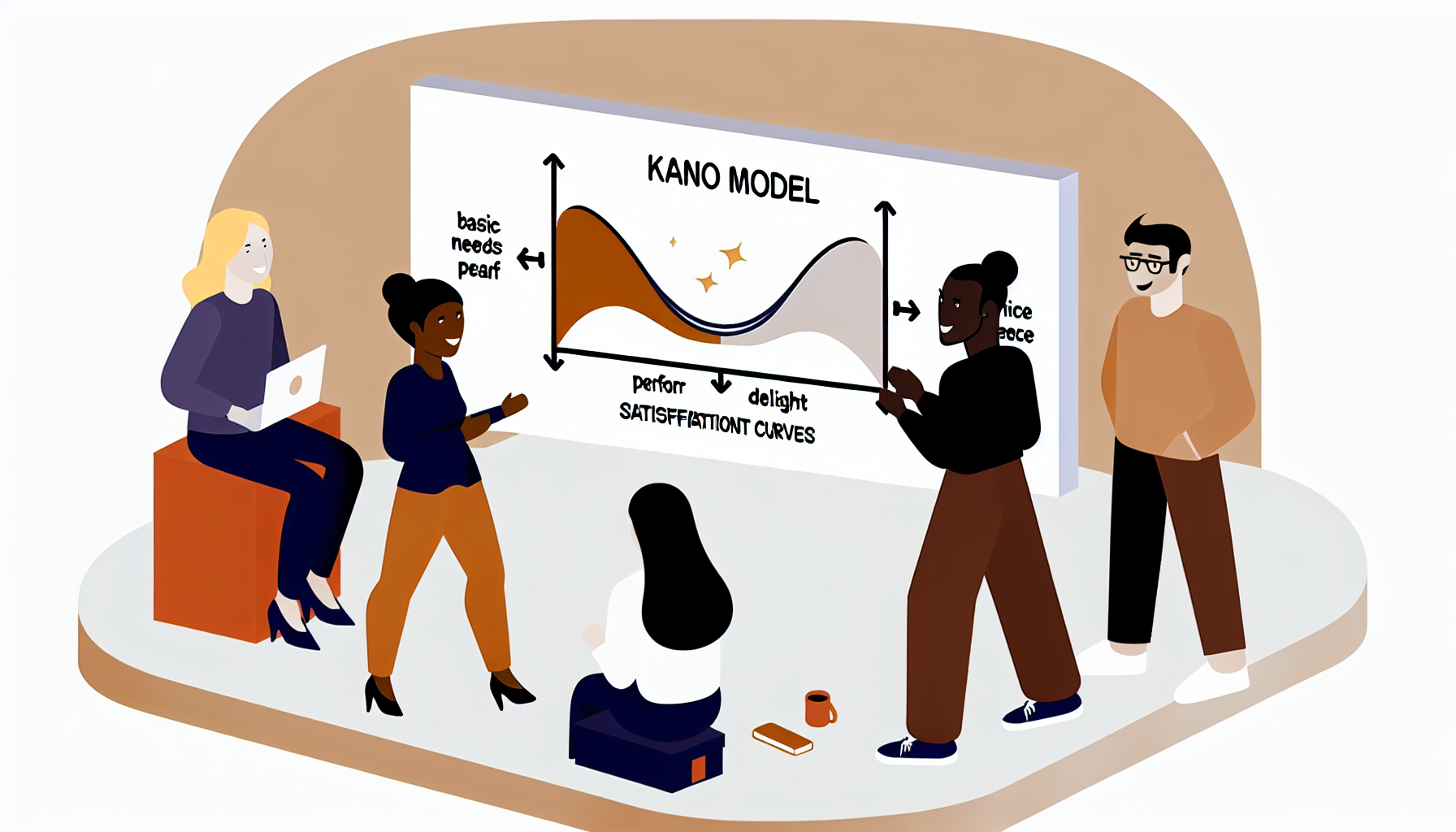
Kano Model
Developed by Noriaki Kano, this model classifies product features by how they affect customer satisfaction. Features fall into five categories: Must-Be (expected, cause dissatisfaction if absent), One-Dimensional (more = better), Attractive (delighters, unexpected), Indifferent (users don't care), or Reverse (some users don't want this). It moves feature discussions beyond gut feel into structured customer insight.
Come eseguirlo
- 1
Create a Kano survey with paired questions for each feature: 'How do you feel if this feature IS present?' and 'How do you feel if this feature is NOT present?'. Each answer: I like it / I expect it / I'm neutral / I can live with it / I dislike it.
- 2
Have participants or target users complete the survey.
- 3
Use the Kano evaluation table to map each response pair to a category (Must-Be, One-Dimensional, Attractive, Indifferent, Reverse).
- 4
Aggregate results across respondents to find the dominant category per feature.
- 5
Prioritise: Must-Be features first (they're table stakes), then One-Dimensional, then Attractive delighters.
- 6
Drop or deprioritise Indifferent and Reverse features.
Suggerimenti
Run Kano with real users or close proxies — don't let the product team fill it in for customers.
Even a small sample (8–12 people) gives usable signal.
Variazioni
For internal workshops without user access, run a proxy Kano where team members roleplay as different user personas. Combine with dot voting for quick feature prioritisation when time is short.
Casi d'uso
Metodi correlati
Domande frequenti
Quando usare Kano Model?▾
Usa Kano Model quando vuoi: Product feature prioritisation; UX research synthesis; Roadmap planning; Customer discovery workshops.
Quanto dura Kano Model?▾
Kano Model dura tipicamente da 45 a 120 minuti.
Per quanti partecipanti è adatto Kano Model?▾
Kano Model funziona meglio per gruppi di 2–20 partecipanti.
Di quali materiali ho bisogno per Kano Model?▾
Per condurre Kano Model avrai bisogno di: list of features, Kano survey form per participant, spreadsheet for analysis.
Quanto è difficile facilitare Kano Model?▾
Kano Model è classificato come intermedio — è utile avere un po' di esperienza di facilitazione.
Pianifica il tuo prossimo workshop con l'IA
Workshop Weaver ti aiuta a combinare metodi come Kano Model in un'agenda completa e temporizzata in pochi minuti.
Prova gratisMethod descriptions on Workshop Weaver are original content written by our team, based on established facilitation practices.