AI can build your workshop agenda in minutes, but it can't sense when the room's energy shifts or navigate hidden political dynamics. Here's where the boundary falls.
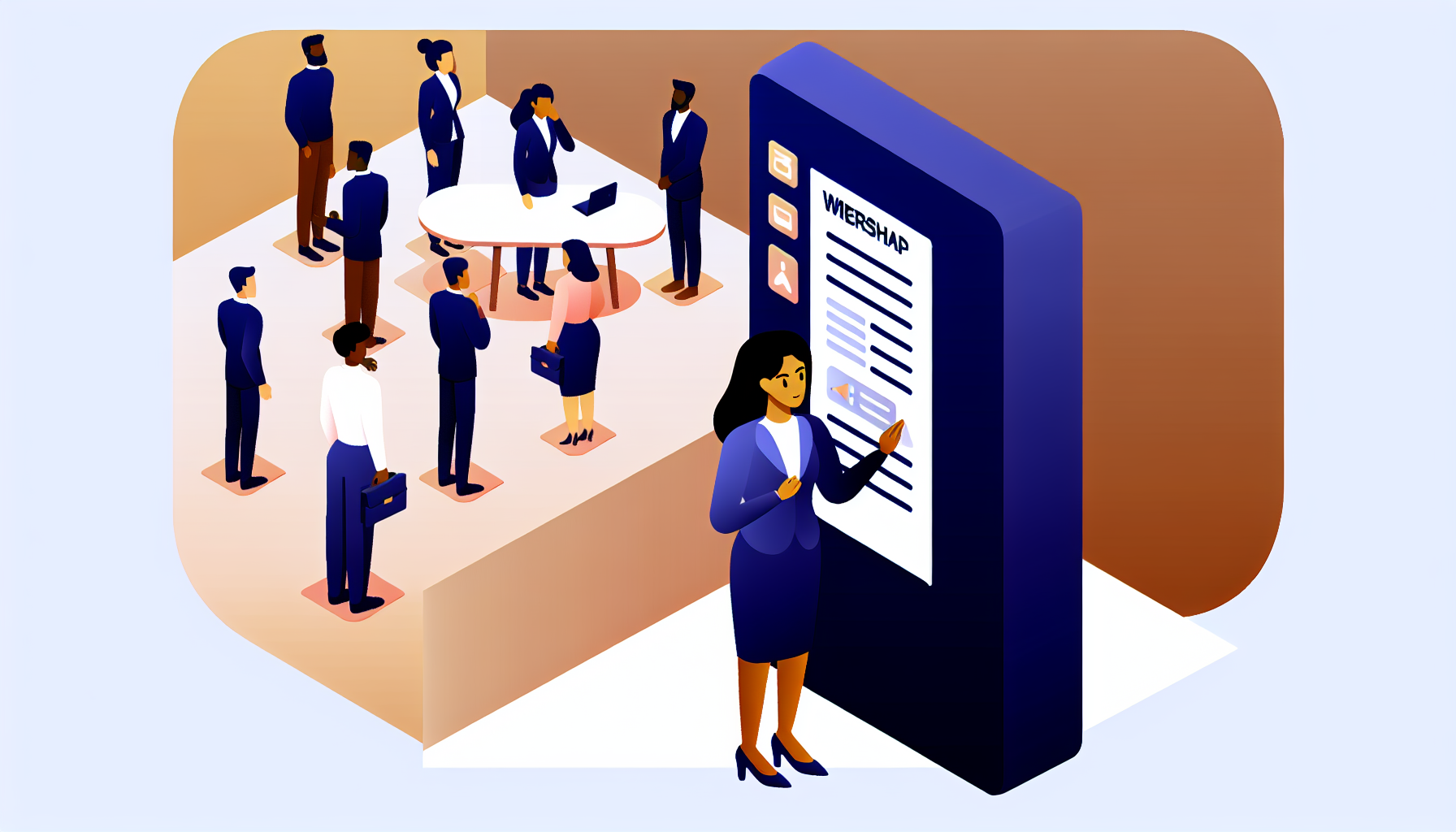
Last week, I fed an AI my workshop objectives, participant list, and time constraints. In 90 seconds, it generated a detailed agenda that would have taken me two hours to create — complete with icebreakers, breakout structures, and timing down to the five-minute break. Yesterday, that same AI would have walked me straight into a political landmine it couldn't see coming, because three of my participants have a history it parsed from no dataset, and the room's energy shifted in ways no algorithm can detect. This is the new reality of facilitation: AI can build your scaffold brilliantly, but only you can sense when the building needs different bones entirely.
What AI Actually Delivers: The Structural Backbone
Let's start with what AI genuinely excels at — and it's substantial. When you're designing a workshop on Workshop Weaver or any other platform, AI can serve as a remarkably capable structural consultant. It synthesizes thousands of facilitation guides, case studies, and methodologies in seconds, recommending evidence-based approaches tailored to your objectives and participant profiles.
A corporate learning designer I spoke with at a Fortune 500 company used ChatGPT to generate five different workshop structures for a diversity and inclusion session, each based on distinct facilitation methodologies — Design Thinking, Liberating Structures, World Café, Open Space. The AI provided timing, materials needed, and learning objectives for each option. She selected one structure but completely rewrote the opening exercise after considering the political sensitivity around recent organizational restructuring — context the AI couldn't grasp.
This division of labor reflects a broader pattern. According to [McKinsey research](https://www.mckinsey.com/capabilities/mckinsey-digital/our-insights/the-economic-potential-of-generative-ai-the-next-productivity-frontier), generative AI can reduce time spent on routine planning and preparation tasks by 30-40%, allowing facilitators to redirect effort toward relationship-building and strategic design decisions. That's not trivial. Two hours saved on agenda creation is two hours you could spend in pre-calls with stakeholders, mapping political dynamics, or simply thinking deeply about what this specific group needs.
AI-powered tools can analyze pre-workshop surveys, participant data, and organizational context to identify themes, surface potential conflicts, and suggest customized icebreakers. They can draft detailed agendas with time allocations, break schedules, and activity sequences that align with adult learning principles and attention span research. The structural foundation is solid, comprehensive, and fast.
But here's what that same MIT Sloan Management Review study revealed: while 68% of professionals using AI assistants for meeting preparation reported improved structural organization, only 12% felt the AI understood interpersonal dynamics. That gap — between structure and sensing — is where the real work of facilitation lives.
The Irreducible Human: Reading Energy and Navigating Politics
Reading a room requires processing hundreds of micro-signals simultaneously: body language, tone shifts, who speaks after whom, patterns of agreement or resistance, energy dips, and unspoken power dynamics. Current AI systems lack the embodied presence and real-time sensory integration necessary for this multidimensional awareness.
Research from the University of Cambridge shows that human facilitators accurately identify group emotional climate shifts with 82% accuracy, while AI emotion recognition systems in meeting contexts achieve only 45-52% accuracy, particularly failing to detect subtle cues like hesitation or performative agreement. That gap matters profoundly when you're holding space for difficult conversations.
Consider this scenario: During a merger integration workshop, a seasoned facilitator noticed that participants from the acquired company went silent whenever the CEO spoke. Her agenda called for open brainstorming next, but she made a split-second decision to shift to anonymous digital submissions instead, preserving psychological safety. Later, she restructured the entire afternoon to create small-group discussions without leadership present. An AI would have executed the planned brainstorm, missing the power dynamic entirely.
Political navigation in organizations involves understanding invisible stakeholder relationships, historical conflicts, unwritten rules, and what cannot be said directly. Experienced facilitators decode these through years of pattern recognition in human systems — contextual knowledge that exists outside any dataset AI can access. You learn that when the CFO and CMO sit at opposite ends of the table, it's not random. You notice that certain topics consistently trigger sidebar conversations. You understand that silence from particular individuals carries different meanings than silence from others.
Holding productive tension — knowing when to lean into discomfort versus when to release pressure — requires judgment calibrated to dozens of contextual factors: organizational culture, psychological safety levels, power differentials, and the specific individuals in the room at that moment. This situational wisdom cannot be reduced to algorithms. A 2024 study in the Journal of Applied Behavioral Science found that 73% of workshop failures were attributed to facilitator inability to adapt to emergent group dynamics, not to structural design flaws. Perfect planning matters less than execution flexibility.
When the Plan Needs to Die: Adaptive Intelligence in Action
Master facilitators develop a sophisticated internal decision framework for when to abandon prepared agendas. Sometimes a breakthrough conversation emerges organically. Sometimes resistance signals deeper issues that need surfacing. Sometimes energy around an unplanned topic indicates the group's real work. This requires pattern recognition across multiple simultaneous dimensions that AI cannot synthesize in real-time.
According to research by the International Association of Facilitators, 64% of experienced facilitators report abandoning or significantly modifying their planned agenda in more than one-third of their sessions, with positive correlation to participant satisfaction scores when the adaptation was responsive to real-time needs. The decision to kill the agenda is rarely about the agenda being bad — it's about recognizing that the living system in the room has surfaced something more important than the predetermined outcome.
A facilitator I know was leading a strategic planning session for a nonprofit board when, 45 minutes in, a trustee made a comment that revealed fundamental misalignment about the organization's core mission. Rather than proceeding with the SWOT analysis as planned, she scrapped the entire agenda and restructured the day around mission clarification and values alignment. The sponsor was initially frustrated, but the session prevented a major governance crisis. She made this call based on reading facial expressions, voice tone, and body language shifts that signaled the comment wasn't an isolated perspective but a hidden fault line.
A Stanford study on collaborative problem-solving found that groups with facilitators who made real-time process adaptations achieved 34% better outcomes on complex challenges compared to groups following rigid predetermined structures, even when those structures were theoretically optimal. The paradox: sometimes the best structure is knowing when to abandon structure.
Effective agenda abandonment also requires political courage and stakeholder management: explaining to sponsors why their carefully planned workshop went off-script, reframing outcomes, and maintaining credibility while embracing uncertainty. These are fundamentally relational and reputational judgments, not computational ones. You need the trust to say, "I know we planned X, but the room is telling me we need Y," and have people follow you into that uncertainty.
The Division of Labor: A Practical Framework for Facilitators
So where does this leave working facilitators? With a clearer map of how to deploy both AI capabilities and human judgment effectively.
AI serves best as a preparation accelerator and structural consultant: use it to generate agenda options, research methods, synthesize pre-work, draft participant communications, and create backup plans. This frees you to focus on stakeholder relationship-building, political mapping, and intuitive preparation for what might emerge. Research from [Gartner](https://www.gartner.com) shows that facilitators using AI for preparation tasks report 40% time savings in planning phases, but 89% still make significant in-session adaptations based on human judgment that AI tools did not anticipate or recommend.
The handoff point between AI contribution and human judgment is precisely at the threshold of real-time human interaction. AI can suggest what to do when energy drops, but only you can sense that energy is dropping in the first place. Only you can read whether the drop signals fatigue, resistance, confusion, or grief. Only you can calibrate the appropriate intervention based on the specific humans in front of you.
The most effective approach treats AI as a junior research assistant with excellent recall but zero contextual judgment. You review its recommendations with full authority to override based on factors the AI cannot access: your relationship with the client, your read of organizational culture, your knowledge of individual personalities, and your embodied sense of what this specific group needs.
A consulting firm I work with developed an internal protocol where facilitators use AI to generate three agenda options and comprehensive background research, then spend saved time conducting one-on-one pre-calls with key stakeholders to understand political dynamics and individual concerns. The AI provides the structural menu; human conversations provide the contextual intelligence that determines which menu item to select and how to modify it. This hybrid approach reduced total preparation time by 25% while improving client satisfaction scores by 18%.
A 2024 survey of 500 professional facilitators found that 71% use AI tools for agenda creation or research synthesis, but only 3% would trust AI recommendations for real-time intervention decisions during live sessions. That 68-point gap tells you exactly where the boundary falls.
What This Means for Facilitator Development
As AI handles more structural and research-intensive work, facilitator training must evolve to emphasize capabilities that AI cannot replicate: somatic awareness, political intelligence, pattern recognition in human systems, and the courage to trust intuition over plans. The profession is shifting from method-mastery to presence-mastery.
The International Coach Federation reports a 156% increase since 2020 in training programs emphasizing somatic awareness, emotional intelligence, and presence skills, reflecting industry recognition that technical facilitation knowledge is increasingly commoditized while human sensing capabilities remain scarce. LinkedIn Learning data shows that courses on AI-assisted meeting design grew 340% in enrollment in 2023, while courses on reading group dynamics and managing difficult conversations grew 287%, suggesting professionals are investing in both AI fluency and distinctively human capabilities in parallel.
New facilitators now have access to AI-generated structural competence that previously took years to develop, allowing them to focus learning time on the subtler arts of reading rooms and navigating complexity. However, this creates a risk: if facilitators rely too heavily on AI scaffolding before building independent judgment, they may struggle when situations demand improvisation that no algorithm anticipated.
A major facilitation training organization redesigned its certification program in 2024 to include AI literacy modules — teaching facilitators how to effectively prompt AI for agenda generation and research — alongside expanded modules on embodied presence, power dynamic awareness, and ethical decision-making under ambiguity. Graduates report feeling simultaneously more efficient in planning and more attuned to the irreplaceable human elements that determine session success.
The future competitive advantage for facilitators lies not in knowing more methods or being faster at agenda design, but in cultivating the qualities AI cannot encode: deep listening, cultural sensitivity, ethical judgment under pressure, and the relational trust that allows groups to follow you into uncertainty.
The Real Work Has Always Been Human
AI isn't a threat to facilitator value — it's a clarifying force that reveals what facilitation was always truly about. Not the agenda, but the attention. Not the method, but the moment-to-moment reading of human systems. Not the plan, but the presence to know when the plan needs to die so something truer can be born.
The facilitators who thrive in this new landscape will be those who embrace AI's strengths to free themselves for more of what only humans can do: read the room with all your senses, hold tension without collapsing it prematurely, navigate politics with wisdom and integrity, and build the relational trust that lets groups venture into emergence.
Here's your invitation to audit your practice: What are you spending time on that AI could do faster? What irreplaceable human capacities are you under-developing because you're still grinding on structural work? Where could you redirect saved preparation time toward the deeper intelligence that no algorithm can replicate?
Use AI to generate your agenda brilliantly. Use your full humanity to sense when that agenda needs to transform. That's not a division of labor — it's a elevation of what facilitation has always demanded. The scaffold was never the building. The structure was never the work. The real work has always been, and will always be, reading the room.
💡 Tip: Discover how AI-powered planning transforms workshop facilitation.
Learn More