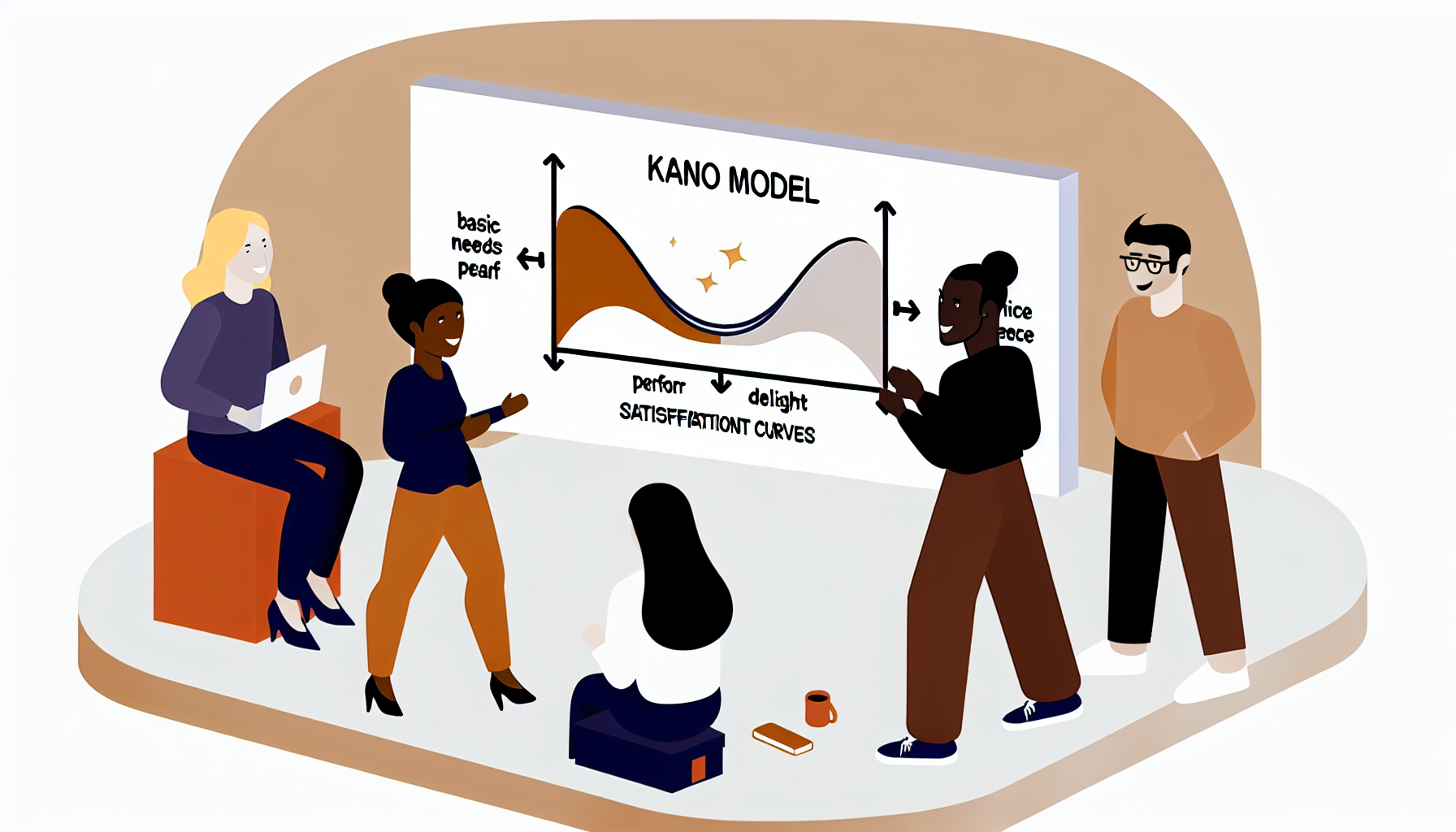
Kano Model
Developed by Noriaki Kano, this model classifies product features by how they affect customer satisfaction. Features fall into five categories: Must-Be (expected, cause dissatisfaction if absent), One-Dimensional (more = better), Attractive (delighters, unexpected), Indifferent (users don't care), or Reverse (some users don't want this). It moves feature discussions beyond gut feel into structured customer insight.
Comment l'animer
- 1
Create a Kano survey with paired questions for each feature: 'How do you feel if this feature IS present?' and 'How do you feel if this feature is NOT present?'. Each answer: I like it / I expect it / I'm neutral / I can live with it / I dislike it.
- 2
Have participants or target users complete the survey.
- 3
Use the Kano evaluation table to map each response pair to a category (Must-Be, One-Dimensional, Attractive, Indifferent, Reverse).
- 4
Aggregate results across respondents to find the dominant category per feature.
- 5
Prioritise: Must-Be features first (they're table stakes), then One-Dimensional, then Attractive delighters.
- 6
Drop or deprioritise Indifferent and Reverse features.
Conseils
Run Kano with real users or close proxies — don't let the product team fill it in for customers.
Even a small sample (8–12 people) gives usable signal.
Variantes
For internal workshops without user access, run a proxy Kano where team members roleplay as different user personas. Combine with dot voting for quick feature prioritisation when time is short.
Contextes d'utilisation
Méthodes associées
Questions fréquemment posées
Quand utiliser Kano Model ?▾
Utilisez Kano Model lorsque vous souhaitez: Product feature prioritisation; UX research synthesis; Roadmap planning; Customer discovery workshops.
Combien de temps dure Kano Model ?▾
Kano Model dure généralement 45–120 minutes.
Pour combien de participants Kano Model convient-il ?▾
Kano Model fonctionne mieux pour des groupes de 2–20 participants.
De quels matériaux ai-je besoin pour Kano Model ?▾
Pour animer Kano Model, vous aurez besoin de : list of features, Kano survey form per participant, spreadsheet for analysis.
Quel est le niveau de difficulté de Kano Model ?▾
Kano Model est classé intermédiaire — une certaine expérience en facilitation est utile.
Planifiez votre prochain atelier avec l'IA
Workshop Weaver vous aide à combiner des méthodes comme Kano Model en un agenda complet et minuté en quelques minutes.
Essayer gratuitementMethod descriptions on Workshop Weaver are original content written by our team, based on established facilitation practices.