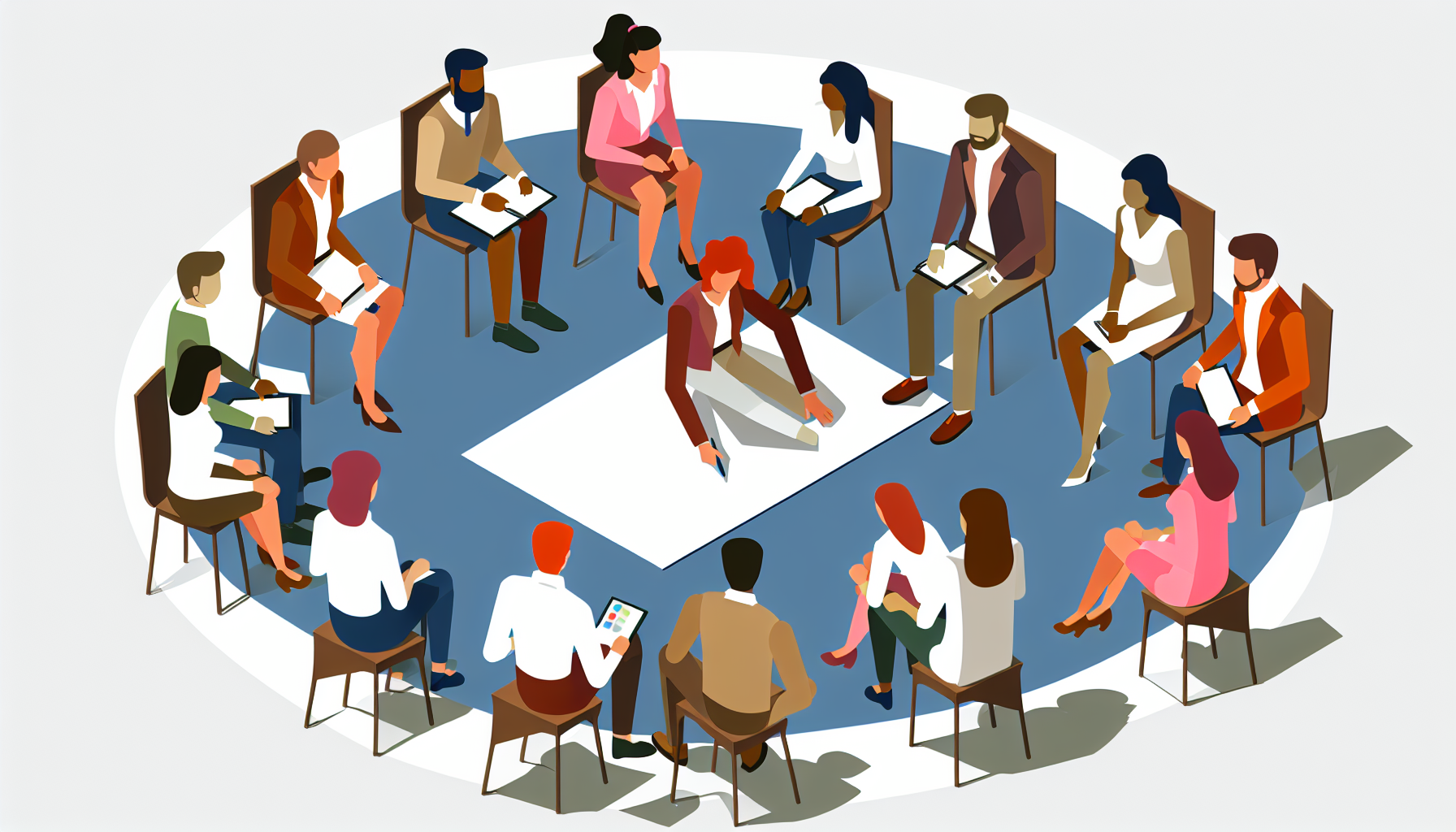
Team Canvas
The Team Canvas is a visual tool that helps teams clarify their goals, values, and roles. It's useful for aligning team members on shared objectives and fostering collaboration.
How to run it
- 1
Set up the Team Canvas on a whiteboard or large paper where everyone can see it.
- 2
Introduce the purpose of the session and explain how the Team Canvas works.
- 3
Ask each participant to reflect on their role and contributions, then write these on sticky notes.
- 4
Invite team members to share their sticky notes and place them on the canvas.
- 5
Facilitate a discussion to identify common themes, goals, and values.
- 6
Encourage the team to agree on actions to enhance alignment and collaboration.
- 7
Document the outcomes and share them with the team after the session.
Tips
Encourage open and honest sharing during discussions.
Keep the atmosphere positive and focused on collaboration.
Use the sticky notes to generate visual diversity in ideas.
Variations
You can modify the session length and focus on specific team aspects, such as only values or roles, depending on team needs.
Where it fits
Frequently asked questions
When should I use Team Canvas?▾
Use Team Canvas when you want to: team kickoff; goal alignment session; retrospective alignment; project realignment meeting.
How long does Team Canvas take?▾
Team Canvas typically takes 90–150 minutes.
How many participants does Team Canvas work for?▾
Team Canvas works best for groups of 2–8 participants.
What materials do I need for Team Canvas?▾
To run Team Canvas you will need: Team Canvas drawn on a whiteboard or large paper, Sticky notes in different colors, one for each participant, Sharpies or pens.
How difficult is Team Canvas to facilitate?▾
Team Canvas is rated intermediate — some facilitation experience is helpful.
Plan your next workshop with AI
Workshop Weaver helps you combine methods like Team Canvas into a complete, timed agenda in minutes.
Try it freeMethod descriptions on Workshop Weaver are original content written by our team, based on established facilitation practices. This method was inspired by work from SessionLab. Licensed under CC BY-SA 4.0.