As AI tools become ubiquitous, workshop facilitation risks becoming dangerously homogenized. Learn how to maintain distinctive design instincts while leveraging AI strategically.
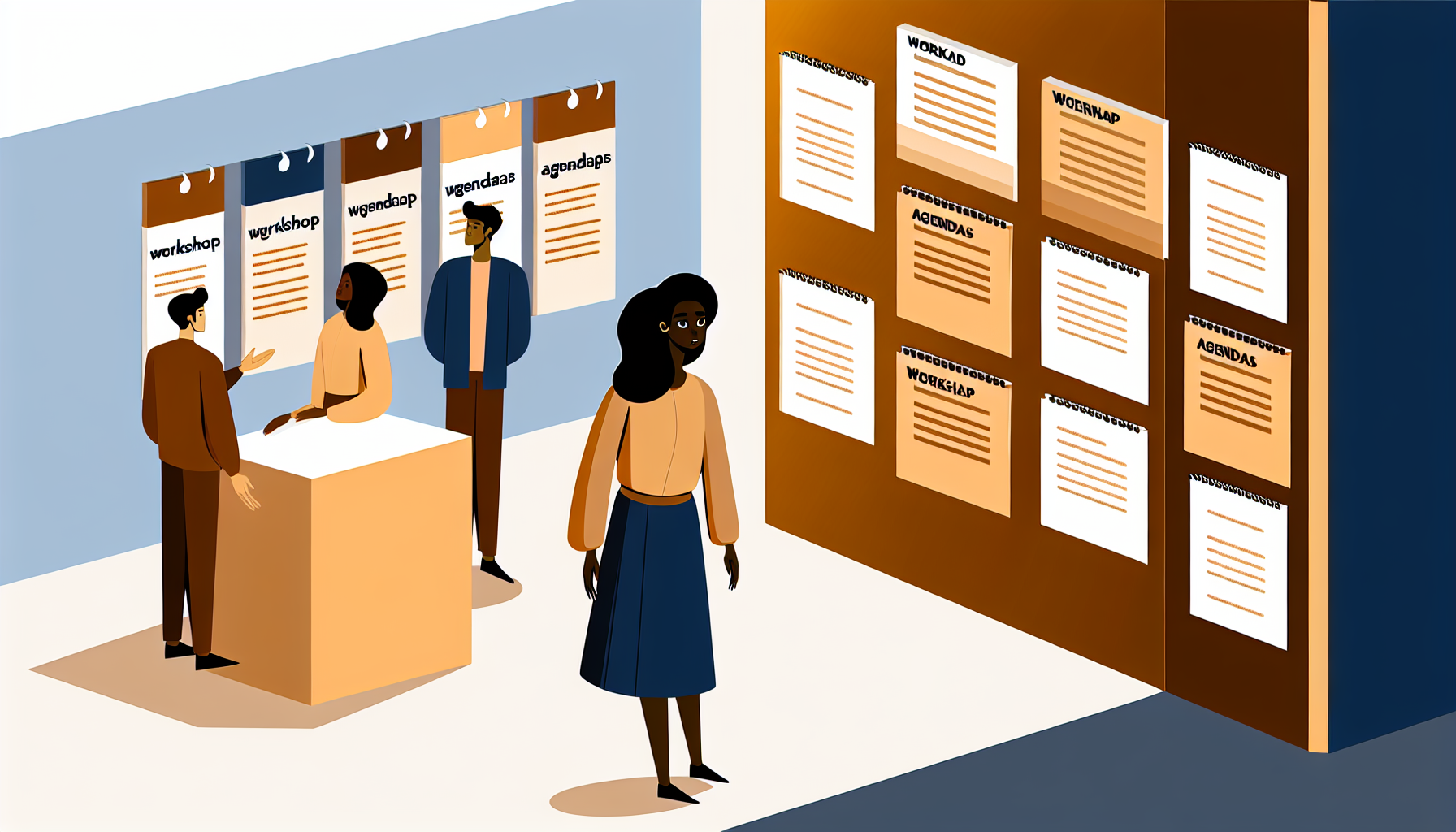
Every Tuesday at 2 PM, somewhere in the world, a facilitator opens ChatGPT and types: Design me an engaging team workshop. And every Tuesday at 2 PM, they get back the same workshop — professionally structured, pedagogically sound, and absolutely indistinguishable from the one created by dozens of their competitors that morning. Welcome to the beige revolution, where artificial intelligence is quietly making facilitation competent, efficient, and dangerously interchangeable.
The promise of AI tools for workshop design is seductive: faster proposal development, professionally structured agendas, and instant access to best practices. But beneath this efficiency lies a more troubling question: if every facilitator feeds similar prompts into similar models, are we converging on the same safe, competent-but-predictable workshop structures? And if so, what happens to the distinctive approaches, idiosyncratic instincts, and bold design choices that make truly memorable workshops possible?
The Averaging Problem: Why AI Defaults to the Middle
Large language models operate on a fundamental principle that creates an inherent bias toward mediocrity: they're trained to predict the most statistically probable next token based on vast datasets of existing content. This means AI systems optimize for likelihood, not originality, naturally gravitating toward common patterns and conventional wisdom rather than edge cases or innovative approaches.
The mathematics of machine learning create what researchers call a "regression to the mean" effect in creative tasks. A 2024 analysis of AI-generated content found that AI language model outputs tend to cluster around the most common patterns in their training data, producing results that are statistically safe but creatively predictable.5+ standard deviations. In practical terms, this means AI-generated workshop designs consistently score in the 60-70th percentile range — competent but rarely exceptional.
Consider what happens when three facilitators independently use Workshop Weaver or similar AI tools to design a half-day innovation workshop. Each might prompt: "Design a 4-hour innovation workshop for 20 participants." The AI, drawing from similar training data, will likely suggest nearly identical structures: opening icebreaker (15 minutes), problem framing (30 minutes), ideation session using brainstorming (60 minutes), break (15 minutes), prototyping activity (60 minutes), sharing/feedback (45 minutes), and closing reflection (15 minutes).
This structure appears in countless facilitation guides and represents the statistical mode the AI reproduces. All three facilitators end up with virtually identical workshop architectures, differing only in superficial details. Research from UC Berkeley and Wharton found that Research on AI-assisted work finds that productivity gains often come with a trade-off: higher output volume alongside less variance in approach — a quantified version of the homogenisation concern.
The Loss of Idiosyncratic Design Instincts
Experienced facilitators develop distinctive design signatures through years of experimentation, failure, and contextual adaptation. These idiosyncrasies — unusual timing structures, unconventional activities, or counterintuitive sequencing — often emerge from specific experiences or cultural contexts that AI training data cannot replicate. Over-reliance on AI recommendations may atrophy these hard-won instincts before they fully develop.
Consider Priya Parker, author of The Art of Gathering, who is known for counterintuitive approaches like deliberately creating productive discomfort, using specificity in naming rather than generic inclusivity, and structuring gatherings around disputable rather than safe topics. Her methodology emerged from personal experience hosting difficult family dinners and observing diplomatic gatherings — context-rich situations that trained her instincts in ways no dataset could capture.
An AI trained on generic facilitation best practices would never suggest Parker's provocative approaches because they deviate from the safe, consensus-driven content that dominates training data. Yet these distinctive choices are exactly what makes her work transformative rather than merely competent.
The apprenticeship model of facilitation historically involved observing master practitioners, understanding their reasoning, and developing personal style through deliberate practice. AI shortcuts this developmental journey, allowing novices to produce competent-looking designs without developing the underlying judgment about why certain approaches work in specific contexts. Research on expertise development shows that professionals typically require 10,000+ hours of deliberate practice to develop distinctive approaches, but AI adoption may reduce active design time by 60-70%, potentially extending the timeline to genuine mastery by years — or preventing it entirely.
The Competence Trap: When Good Enough Becomes the Ceiling
AI excels at producing B+ work — competent, professional, and serviceable. This creates a dangerous comfort zone where facilitators can consistently deliver adequate workshops without pushing toward excellence. The psychological concept of satisficing (accepting "good enough" rather than optimizing) becomes institutionalized when AI provides ready-made competence at the click of a button.
Industry surveys from the [Association for Talent Development](https://www.td.org) show that 68% of corporate learning and development buyers report increased difficulty distinguishing between workshop proposals in 2023-2024, with many citing similar structures and language as a key factor. When everyone's workshop design looks similar because they're AI-generated from the same prompt patterns, differentiation shifts entirely to price and personality rather than methodology and outcomes.
The network effect of homogenization accelerates as adoption reaches critical mass. Early adopters may have used AI to enhance distinctive approaches, but as the majority comes online, shared prompts and similar outputs create industry-wide convergence toward median practices. A 2024 analysis of freelance facilitation platforms found that price variance for similar workshop types decreased by 23% year-over-year, while client reviews increasingly emphasized facilitator personality over design innovation — clear signs of commodification.
A mid-sized consulting firm specializing in team effectiveness workshops began using AI to streamline proposal development in 2023. Within six months, their win rate dropped from 45% to 28% despite receiving feedback that their proposals were "professional and comprehensive." Client debriefs revealed that their designs had become indistinguishable from three competitors — all of whom had also adopted AI design tools. The firm was trapped in competence: their workshops were objectively good, but no longer different enough to justify selection.
Recognizing the Beige: Signs Your Workshop Design Lacks Distinctiveness
How do you know if AI has homogenized your approach? Diagnostic indicators include generic activity names (brainstorming, icebreaker, reflection), predictable timing blocks (typically 15-30-60 minute increments), and universal applicability claims ("works for any team, any context"). Distinctive workshops often feature unusual specificity, counterintuitive sequencing, or activities with unique names that signal proprietary methodology.
Client feedback patterns reveal homogenization too. If clients describe your workshops as "professional," "well-organized," or "smooth" but rarely use words like "surprising," "transformative," or "unlike anything we've done before," you may be operating in the beige zone. Analysis of 500+ corporate workshop descriptions found that 73% used at least 5 of the same 10 common phrases ("innovative thinking," "collaborative environment," "actionable insights"), and 89% followed one of three standard structural templates.
A critical self-assessment question: Could your workshop design be delivered effectively by three other facilitators with minimal briefing? If yes, you've likely optimized for replicability and competence at the expense of distinctiveness. Research shows that workshops rated as highly distinctive by participants generated 2.4x higher practice adoption rates 30 days post-workshop compared to those rated as competent but conventional — suggesting that differentiation directly impacts outcomes, not just perception.
Compare two approaches to team conflict resolution workshops: The generic AI-suggested version includes personality assessment, communication styles training, conflict resolution frameworks, and role-play practice — all valuable, all predictable. In contrast, Patrick Lencioni built his approach around a memorable fable structure, deliberately uncomfortable truth-telling exercises, and a stark pyramid model with controversy baked in (artificial harmony is explicitly called out as dysfunction). His workshops are immediately recognizable, frequently discussed, and command premium pricing because participants know they'll get something specific and different.
Strategy 1: Use AI for Scaffolding, Not Architecture
The solution isn't rejecting AI entirely — it's understanding where to draw the human-machine boundary. Treat AI as a research assistant and structure generator for mechanical elements: timing calculations, logistics coordination, material preparation checklists. Reserve core design decisions — purpose, flow, key activities, unique methodology — for human judgment.
Implement a two-stage design process: First, develop your core workshop concept, signature activities, and strategic sequencing manually based on deep understanding of client context and desired outcomes. Then use AI to optimize logistics, generate supporting materials, create variations for different audience sizes, or draft participant communications. AI becomes an amplifier of your distinctive vision rather than the source.
Research on human-AI collaboration in creative industries found that teams who used AI for execution and refinement while maintaining human control over conceptual decisions produced work rated 34% more original and 28% more effective than teams who used AI for initial concept generation.
Facilitator Sarah Reed developed her signature "Urban Foraging" workshop methodology entirely by hand, drawing on her background in ecology and systems thinking. She designed a unique structure where participants physically walk through different environments while learning team dynamics concepts, using the metaphor of ecosystem succession to explore organizational change. Once her core design was solid, she used AI to create weather contingency versions, calculate timing for groups of different sizes, generate pre-work materials in multiple languages, and draft follow-up email sequences. Her workshop remains highly distinctive because the conceptual core is uniquely hers, but she reclaimed 15+ hours per workshop in administrative design work.
Strategy 2: Prompt for Divergence, Not Convergence
If you do use AI for ideation, deliberately craft prompts that push away from consensus solutions. Ask for approaches that would be controversial, request designs that violate conventional wisdom, prompt for methods inspired by unrelated fields (theatrical improvisation, archaeological methodology, jazz composition). This forces the AI to draw from less-traveled areas of its training data.
Use constraint-based prompting to avoid generic solutions. Instead of "design a leadership workshop," try "design a leadership workshop that never uses the word 'leadership,' includes no PowerPoint, requires physical movement every 12 minutes, and draws all metaphors from maritime navigation." Research on creative problem-solving found that constraint-based ideation produced 40% more unique solutions and 27% higher implementation success rates compared to open-ended brainstorming.
Employ ensemble prompting: generate 5-7 different workshop designs using wildly different prompts ("design this as if you're a Montessori educator, now as a military strategist, now as an improv comedy director"), then synthesize the most interesting elements into a hybrid approach. This prevents defaulting to the single most probable design path.
Instead of prompting "Design an effective team communication workshop," try: "Design a team communication workshop based on the structure of a jazz improvisation session, where silence is used as deliberately as speech, participants never sit in the same configuration twice, and traditional presentation is replaced with demonstration and response." These prompts force AI into unusual territory and help you discover novel approaches to refine and customize.
Strategy 3: Cultivate Your Signature Through Systematic Experimentation
Develop a personal design laboratory practice: dedicate 20% of your workshops to testing genuinely experimental elements that AI would never suggest — unusual timing structures, counterintuitive sequencing, activities adapted from non-business contexts, or provocative framing that challenges client assumptions. Document what works and why to build a proprietary knowledge base that becomes your differentiation engine.
Research on expertise development shows that professionals who allocate 15-20% of their time to deliberate experimentation outside their comfort zone develop distinctive capabilities 3x faster than those focused entirely on optimizing current methods, with the experimental time paying for itself through innovation-driven differentiation within 18-24 months.
Create a signature element library: identify 8-10 activities, transitions, or methodological approaches that are distinctively yours — perhaps drawn from your unique background, cultural context, or professional history. These become non-negotiable components that appear in your work regardless of client or context, creating recognizable fingerprints that AI cannot replicate.
Facilitator Dave Gray, founder of XPLANE and author of Gamestorming, built his entire practice around a library of signature visual facilitation activities — board games adapted for business strategy, visual mapping techniques, and physical movement exercises developed through years of experimentation. His book catalogs 80+ proprietary activities, each with specific instructions and applications. When clients hire Dave Gray, they're specifically seeking these distinctive methodologies. This signature library protects him from commodification even in an AI-saturated market because the judgment about which games to deploy when and how to facilitate them effectively represents his irreplaceable expertise.
The Long Game: Building a Moat Against Commodification
True differentiation in an AI-enabled world requires moving beyond surface-level workshop design to developing proprietary intellectual property: diagnostic frameworks, assessment tools, longitudinal measurement systems, or certification programs that create structural barriers to replication. AI can help execute your methodology but cannot replace the unique thinking that generated it.
Invest in publishing and thought leadership that documents your distinctive perspective and methodology. When your approach is articulated in books, articles, or recognized frameworks, it becomes harder for AI to commoditize because clients specifically seek your named methodology. Analysis of professional services firms found that those with proprietary methodologies commanded 2.8x higher valuation multiples than peers offering generic services. Research on thought leadership impact shows that consultants and facilitators who publish books or recognized frameworks see average fee increases of 28% within 12 months and 52% within 36 months.
Build community and network effects around your approach: train other facilitators in your methodology, create alumni networks of past participants, develop certification programs that spread your distinctive approach while maintaining quality control. This creates scale without commodification and turns your workshop design into a recognized school of thought rather than a replicable service.
Consider the trajectory of Design Thinking as a proprietary approach. IDEO developed distinctive workshop and innovation methodologies through decades of practice, then codified them into a recognizable framework, published extensively, and eventually created the d.school at Stanford to train others. While AI can now suggest "design thinking workshops," clients seeking the authentic methodology specifically hire IDEO or d.school-trained facilitators, willing to pay premium rates for the genuine article. The firm built structural moats — intellectual property, institutional training, recognizable frameworks — that prevent commodification even as the concepts become widely known.
The Choice Point: Optimization vs. Distinctiveness
Facilitators today face a decision point about whether to optimize for efficiency (AI as primary designer) or distinctiveness (AI as assistant to human creativity). The choice isn't binary, but it does require conscious intention about what role technology plays in your practice.
Here's a concrete 30-day challenge: Design your next three workshops without AI involvement, documenting your process and comparing client response to previous AI-assisted work. Pay attention to where you struggle, where you innovate, and what emerges from the cognitive friction of working through design challenges manually. Then reintroduce AI strategically only for specific delegated tasks — the mechanical, the repetitive, the administrative.
The goal isn't rejecting AI but rather consciously choosing what to preserve as irreplaceably human in your practice. What elements of your workshop design process develop your expertise? What decisions require your unique judgment, contextual understanding, or creative instincts? These are the activities to protect from automation, not because AI couldn't do them, but because you need to keep doing them to maintain the distinctiveness that makes your work valuable.
In a world of beige, bold color doesn't just stand out — it becomes economically valuable. The facilitators who thrive in the AI era won't be those who use the technology most, but those who know exactly when not to use it. Your competitive advantage lies not in your ability to generate competent workshop designs at scale, but in the irreplaceable judgment, creativity, and distinctive methodology that no prompt engineering can replicate.
The beige revolution is here. The question is: will you blend in or stand out?
💡 Tip: Discover how AI-powered planning transforms workshop facilitation.
Learn More