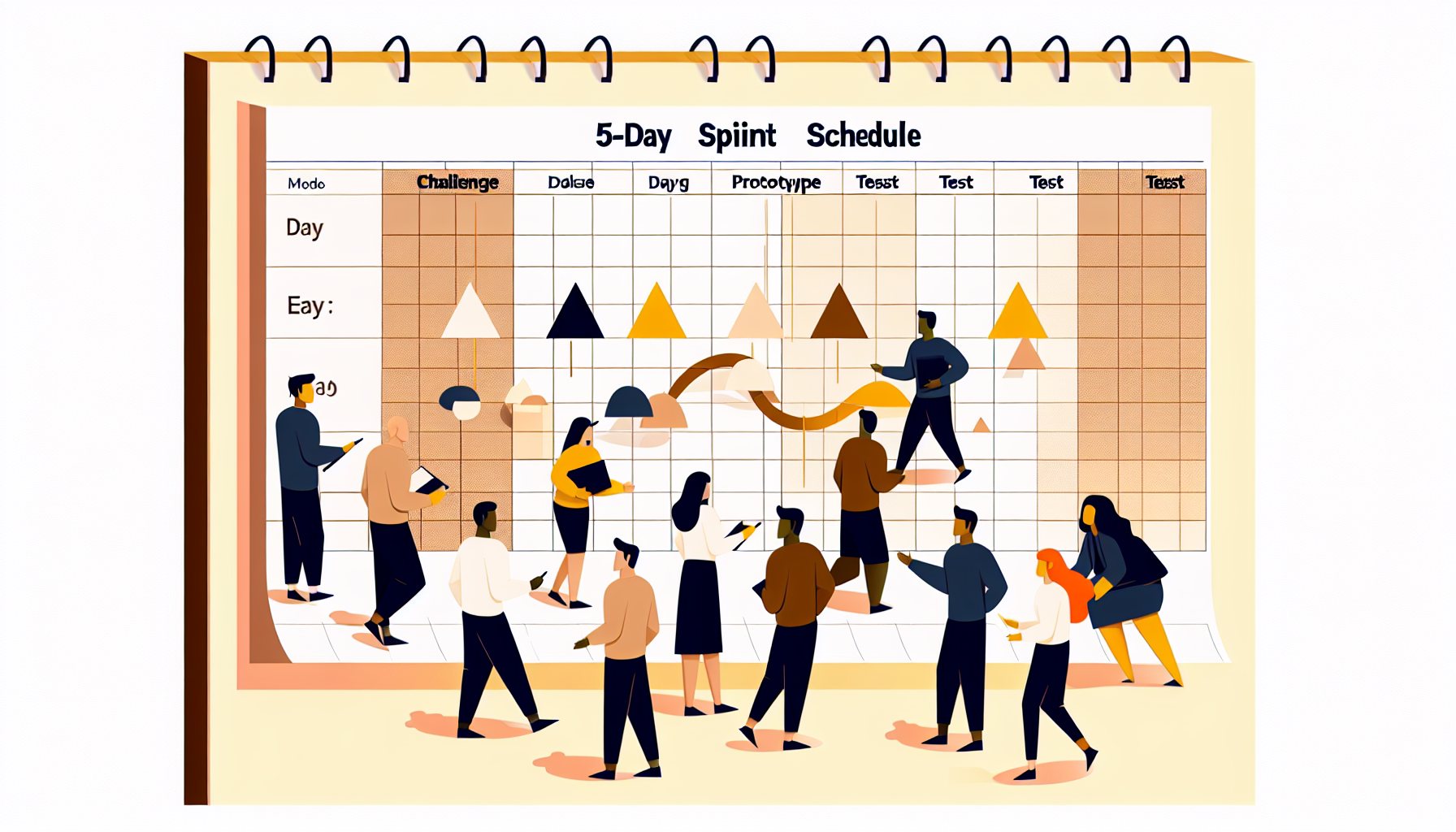
Design Sprint
A five-day intensive framework developed at Google Ventures by Jake Knapp. Each day has a specific focus: Map (understand the problem), Sketch (generate individual solutions), Decide (select the best approach), Prototype (build a realistic-looking prototype), and Test (validate with five real users). It compresses months of iterative work into one week, producing a tested prototype and real user data before a single line of code is written.
How to run it
- 1
Day 1 — Map: Agree on a long-term goal, map the challenge, and pick a target. Interview experts.
- 2
Day 2 — Sketch: Review inspiration, individual brainstorming, Crazy 8s, solution sketching.
- 3
Day 3 — Decide: Sticky decision (silent dot voting), speed critique, storyboard for the prototype.
- 4
Day 4 — Prototype: Build a realistic but fake prototype in one day. Divide roles: Makers, Stitcher, Writer, Asset Collector, Interviewer.
- 5
Day 5 — Test: Five 1:1 user interviews. Team watches via video link. Debrief patterns across interviews.
- 6
Capture learnings and decide on next steps.
Tips
No devices in the room during the sprint (except for designated research).
The Decider (product/business owner) must be present the entire time — decisions cannot be delegated.
Five users is the minimum for reliable pattern recognition.',
Variations
Run a 3-day or 4-day sprint by compressing phases. Use a 'sprint light' for smaller questions that don't require a full week. Remote sprints work with the right digital tooling (Miro, Figma).
Where it fits
Plan your next workshop with AI
Workshop Weaver helps you combine methods like Design Sprint into a complete, timed agenda in minutes.
Try it freeMethod descriptions on Workshop Weaver are original content written by our team, based on established facilitation practices. This method was inspired by work from Community.