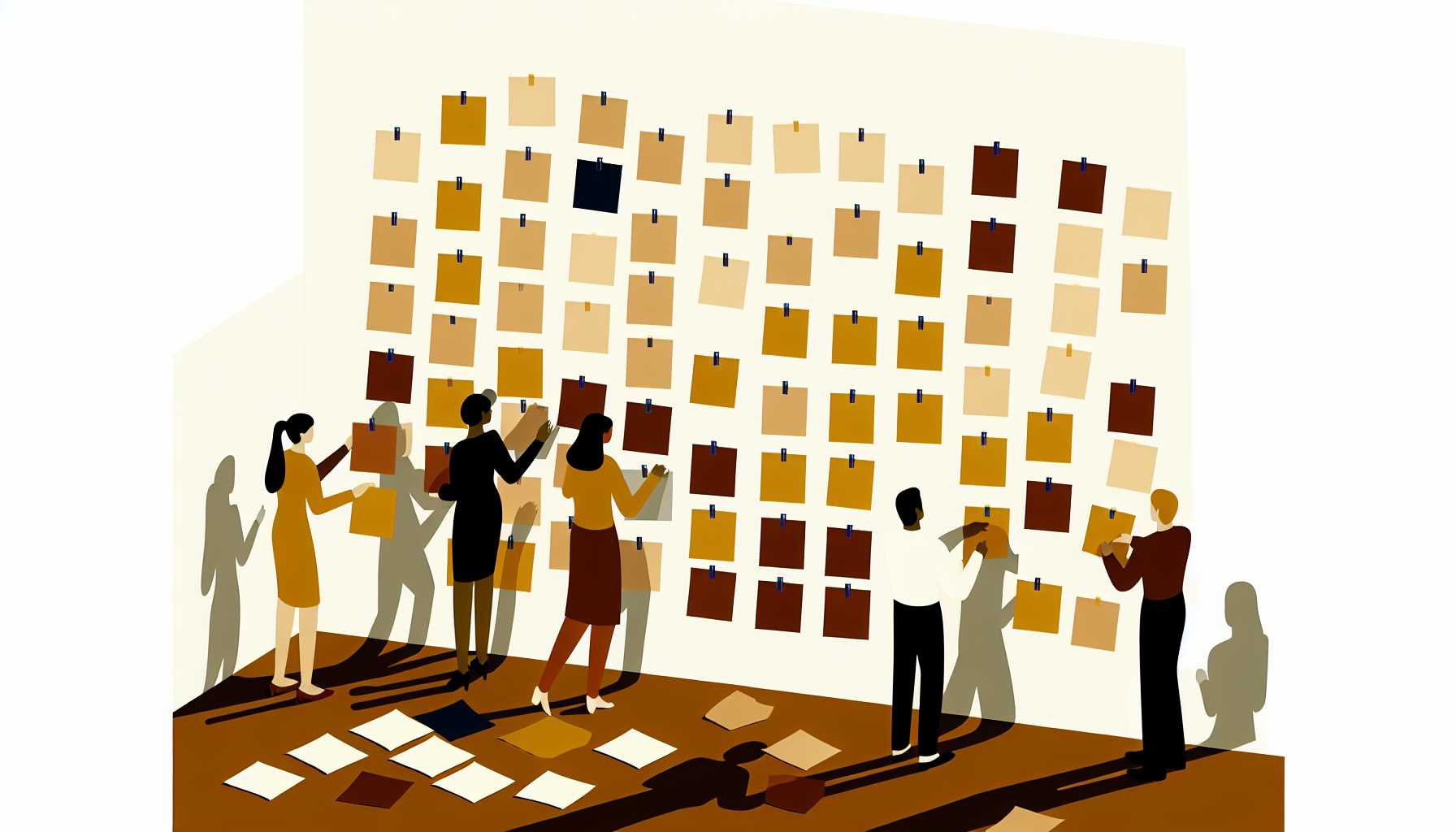
Affinity Map
Affinity Mapping is a technique used to organize ideas and data into meaningful clusters. It is ideal for identifying patterns and themes within a large set of information, making it useful for brainstorming follow-up sessions where categorization is needed.
How to run it
- 1
Write a central question on a flip-chart paper that participants will respond to.
- 2
Have participants silently generate ideas on sticky notes for 10 minutes.
- 3
Collect and display all sticky notes on a visible surface.
- 4
Sort the notes into clusters based on relationships, involving participants in the process.
- 5
Create a 'parking lot' for ideas that don't fit into any category.
- 6
Label each cluster with a category name agreed upon by the group.
Tips
Ensure participants understand the importance of identifying relationships among ideas.
Encourage them to focus on grouping rather than labeling initially.
Manage the balance between too many or too few categories to maintain clarity in analysis.
Variations
Consider running the activity twice to explore different perspectives on how ideas can be grouped. This can reveal less obvious relationships and patterns.
Where it fits
Plan your next workshop with AI
Workshop Weaver helps you combine methods like Affinity Map into a complete, timed agenda in minutes.
Try it freeMethod descriptions on Workshop Weaver are original content written by our team, based on established facilitation practices. This method was inspired by work from Gamestorming.